EUDR Supply-Chain Intelligence
EUDR compliance does not need prettier maps. It needs defensible pixels.
Why satellite maps alone do not create EUDR compliance, and why it comes down to reproducible, reviewable decisions at pixel level.
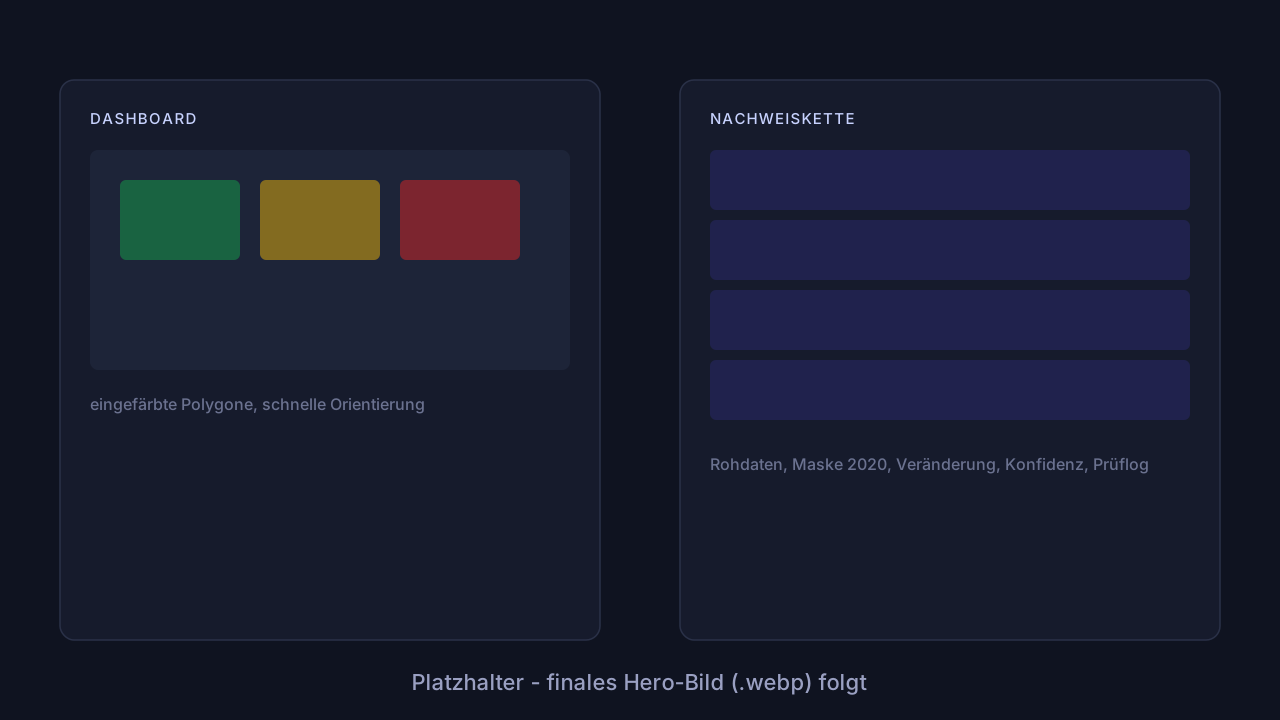
A satellite image does not make a supply chain compliant.
This sounds obvious, but in many discussions around the EU Deforestation Regulation it is exactly the missing point. Companies look at maps, risk layers, dashboards and colored polygons. Green means safe. Red means risk. Yellow means maybe.
But the real question starts one step later:
Can you explain why this specific area was classified like this?
Not in a marketing presentation. Not in a screenshot. But in a way that can be reviewed, reproduced and challenged.
That is the difference between a nice satellite dashboard and a defensible EUDR process.
The problem is not only traceability
EUDR is often discussed as a traceability problem. Where did the cocoa, coffee, soy, palm oil, rubber or timber come from? Can we identify the plot? Do we have geolocation data?
This is necessary. But it is not enough.
Once the location is known, the next question appears immediately:
Was this area forest before? Was there deforestation after the relevant cut-off date? Is the current crop located on land that should be considered problematic? How confident are we in this assessment?
And then comes the most uncomfortable question:
How exactly did we come to this conclusion?
This is where many systems become weak. They show a result, but not a defensible path to the result.
A map is not an audit trail
A map can be useful. A map can show risk. A map can help a compliance team to decide where to look first.
But a map alone is not an audit trail.
A colored pixel on a map does not tell us which data source was used. It does not tell us which preprocessing steps were applied. It does not tell us how clouds were handled, how thresholds were selected, which forest baseline was used, or whether different data sources disagreed.
In a real audit situation, these details matter.
Because the question will not be:
“Did your dashboard show green?”
The question will be:
“Why did your system classify this plot as low risk, although another source shows possible forest loss?”
This is a completely different level of accountability.
What pixel-level auditability means
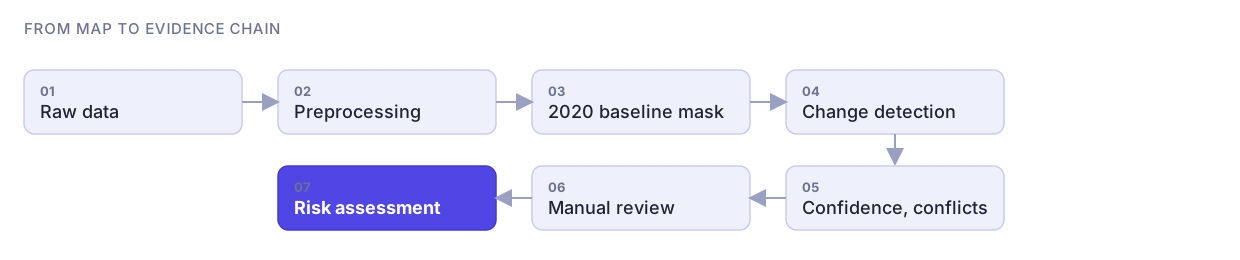
Pixel-level auditability means that relevant classification decisions can be traced back to their technical basis.
For one pixel, or one group of pixels, we should be able to answer:
Which satellite data was used? Which date range was evaluated? Which forest baseline was applied? Which change detection method was used? Which masks were active? Which threshold created the final decision? Was there disagreement between data sources? Was the result automatically accepted or manually reviewed?
This is not bureaucracy. This is engineering discipline.
In software development, we would never accept a production system where nobody knows which code version produced an output. In machine learning, we use experiment tracking, model versions and reproducible pipelines.
For EUDR monitoring, the same principle should apply to geospatial decisions.
The 2020 baseline problem
One of the hardest parts of EUDR-related analysis is the baseline question.
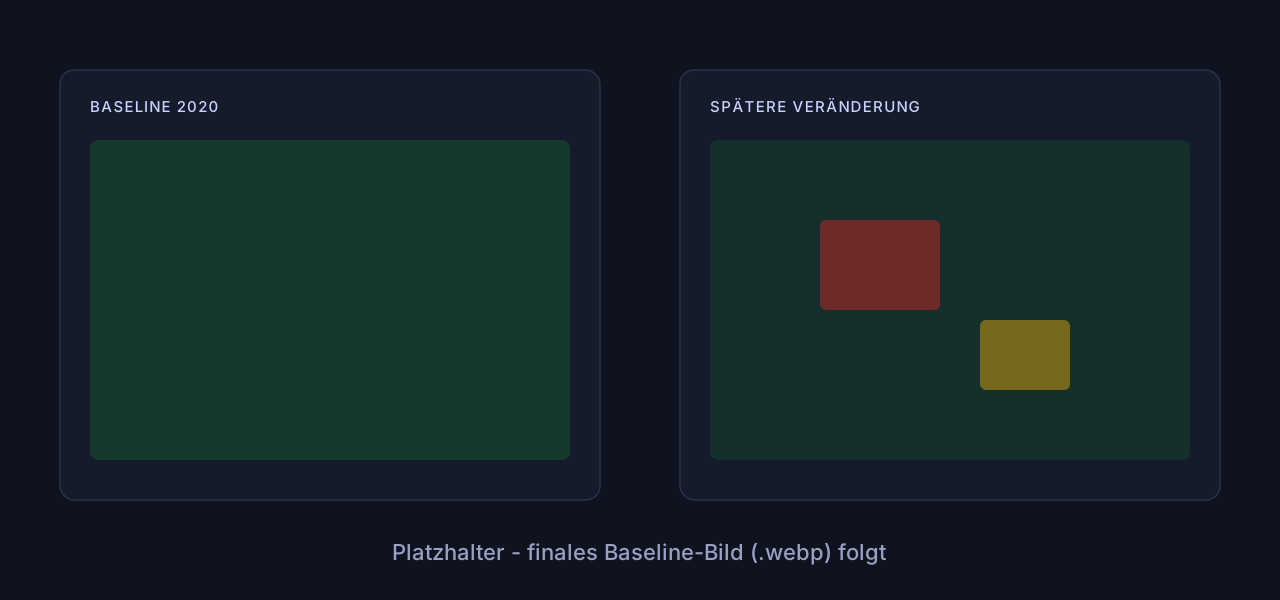
It is not enough to know what an area looks like today. We need to understand what it was around the relevant historical reference point and whether meaningful change happened afterwards.
This is not always trivial.
Forest maps are not perfect. Satellite imagery has cloud cover. Optical data can be missing. Radar data behaves differently from optical imagery. Smallholder plots can be small. Tree crops can look structurally similar to forest. Boundaries may be imprecise.
This does not make satellite analysis useless. It only means that the output must be handled with intellectual honesty.
A serious EUDR risk system should not pretend to produce absolute truth. It should produce a documented, reproducible and reviewable risk assessment.
That is a much stronger position.
Why one data source is usually not enough
A single map is convenient. But convenience is not the same as robustness.
In practice, different geospatial layers may disagree. One source may show forest. Another source may show tree crops. A third source may indicate disturbance. A fourth source may have low confidence for the same area.
This disagreement is not a bug. It is valuable information.
A good system should preserve such disagreement instead of hiding it behind one simple traffic-light color.
For procurement and compliance teams, this is important. A red flag does not automatically mean a violation. A green flag does not automatically mean safety. The real value is in the explanation behind the flag.
This is why EUDR monitoring should not be built as a pure visualization product. It should be built as an evidence pipeline.
From dashboard thinking to evidence thinking
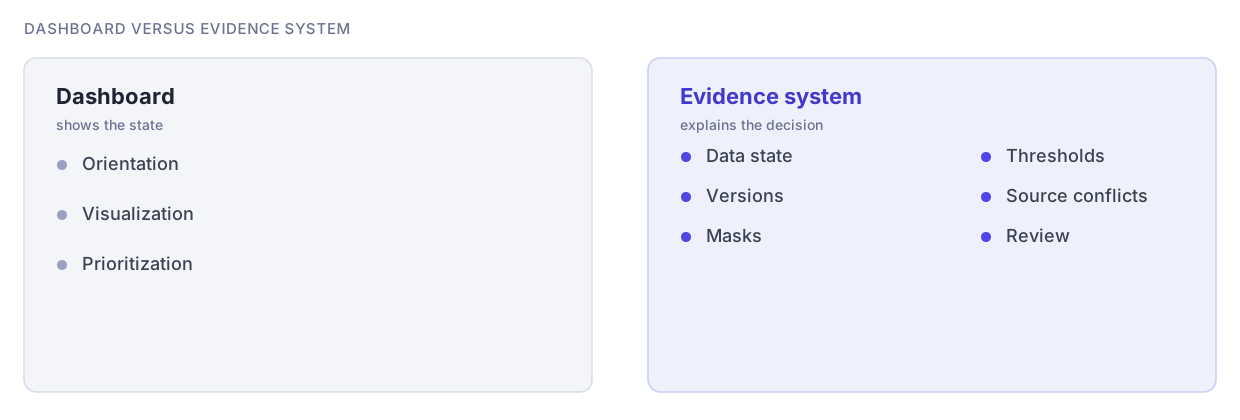
Many dashboards are designed for quick orientation. That is useful at the beginning. But EUDR requires more than orientation.
A defensible process needs a chain of evidence.
That chain should include:
- the raw input data,
- the preprocessing steps,
- the spatial resolution,
- the temporal window,
- the forest and non-forest masks,
- the change detection logic,
- the confidence score,
- the final classification,
- and the human review, where needed.
The point is not to make the system complicated. The point is to make it explainable when it matters.
Because when a shipment, a supplier or a production batch is questioned, nobody will care how elegant the dashboard looked.
They will care whether the decision can be reconstructed.
A practical approach: separate baseline and change
One useful way to think about this is to separate two questions.
First:
What was this area at the baseline?
Second:
Did relevant change happen afterwards?
These are related questions, but they are not the same question.
The first question needs a forest or land-cover baseline. The second question needs time-series analysis and change detection. Mixing both into one black-box score makes the result harder to defend.
A better approach is to treat the process as layered evidence.
One layer describes the baseline. One layer describes later changes. One layer describes confidence. One layer describes conflicts between sources. One layer captures manual review.
The final risk assessment is then not just a color. It is a conclusion based on traceable intermediate steps.
This is what we mean by defensible pixels.
Why this matters for companies
For companies, the risk is not only technical. It is operational, legal and reputational.
A buyer, compliance officer or sustainability manager does not need another abstract AI promise. They need a system that helps them make better decisions under uncertainty.
They need to know which suppliers are low risk. They need to know where additional documentation is required. They need to know which plots should be reviewed manually. They need to know when a risk signal is strong enough to stop, investigate or escalate.
And they need to know this before the problem becomes public.
This is why the audit trail is so important. It protects the company not by pretending that risk does not exist, but by showing that risk was assessed in a structured, serious and reproducible way.
The wrong promise
The wrong promise is:
“We can prove EUDR compliance automatically from satellite data.”
That sounds attractive, but it is too strong.
Satellite data can support due diligence. It can identify risk. It can show change patterns. It can provide early warning. It can reduce blind spots.
But it does not replace legal responsibility, supplier documentation or serious compliance work.
The better promise is:
“We help you build a defensible geospatial evidence layer for EUDR risk assessment.”
That is less spectacular. But it is more honest. And in practice, it is much more valuable.
The role of AI
AI can help in this process, but AI is not the magic word here.
The important part is not that a model produces a classification. The important part is that the classification can be explained, versioned and reviewed.
A model without traceability is a liability.
A model inside a reproducible evidence pipeline can be an asset.
This distinction is important. Especially in regulated environments, the question is not only whether the model is accurate. The question is whether the whole process is defensible.
Accuracy without auditability is not enough.
Conclusion
EUDR compliance will not be won by the prettiest satellite map.
It will be won by companies that can show how they assessed risk, which data they used, where uncertainty remained and how decisions were documented.
The future of EUDR monitoring is therefore not only geospatial analytics. It is geospatial auditability.
Not just dashboards. Not just colored polygons. Not just AI scores.
Defensible pixels.
That is where the real work begins.
Sources
- Regulation (EU) 2023/1115 on deforestation-free products.
- European Commission, Regulation on deforestation-free products.
- Joint Research Centre, Global Forest Cover map for the year 2020 (GFC2020).
- Joint Research Centre, geospatial tools supporting EUDR risk assessment.
Disclaimer
This article describes a methodological position from our own research practice. It is not legal advice and not a proof of compliance. Satellite data supports a documented, reproducible and reviewable risk assessment; it does not replace legal responsibility or supplier documentation. GFC2020 and comparable Joint Research Centre tools are supporting, not mandatory, not exclusive and not legally binding.