Generative AI
AI slop: why the web is filling up with junk
Where the term comes from, documented examples, and the patterns that help you spot mass-generated content.
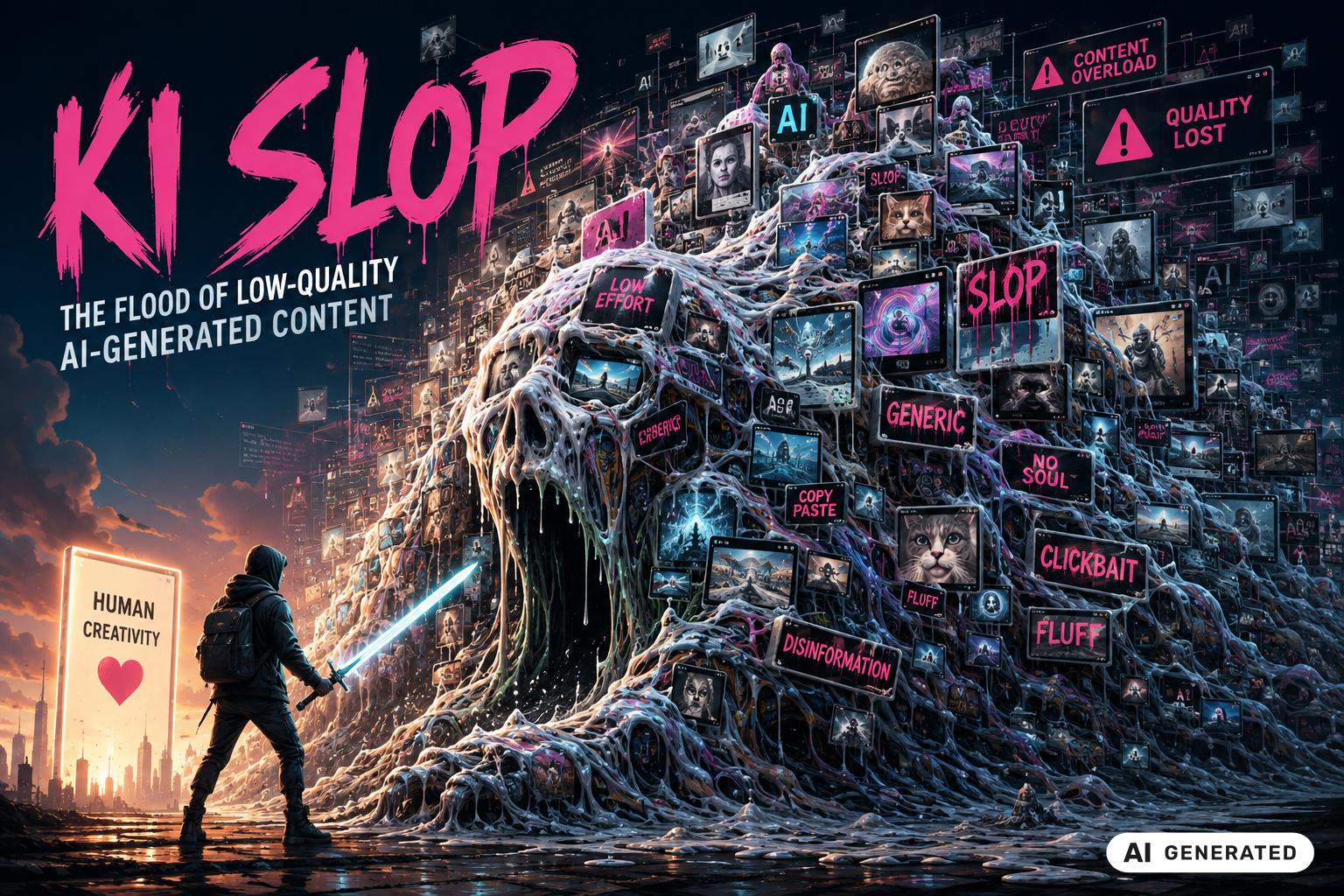
AI slop is content mass-produced with generative AI, published without human review and aimed solely at reach: clicks, ad revenue and visibility in search engines. The term describes a practice rather than a technology: publishing without selection, without review and without anyone putting their name to the result.
Anyone browsing search results, social networks or online bookshops in the summer of 2026 encounters this material daily. This article traces where the term comes from, which forms are documented, why the flood follows straightforward economics and how you can spot AI-generated content. It deliberately does not declare every use of AI a problem; instead it distinguishes between responsibly reviewed AI content and unreviewed, mass-published output. That distinction gives the term AI slop its analytical precision.
Where the term comes from
In English, slop is the watery kitchen waste fed to pigs. Applied to AI, the word first circulated in forums: around 2022 it appeared on 4chan and Hacker News as a dismissive label for generated images (overview on Wikipedia). It reached a wider audience in May 2024, when the programmer Simon Willison argued that slop should be used the way spam once established itself for unwanted email: as the collective term for unwanted AI content (Willison, 8 May 2024). His distinction remains the most useful one. Slop is what is mindlessly generated and pushed at people who never asked for it.
The term has since taken hold. Merriam-Webster named slop its Word of the Year 2025, and in January 2026 the American Dialect Society made the same choice. So if you ask what AI slop means, the short answer reads: the industrial bulk commodity among content, recognisable less by the tool than by the absence of a sender who stands behind it.
Four documented forms
Content farms in the search index
The analytics firm NewsGuard counts websites that pose as news outlets but generate their articles largely by machine and without editorial oversight. When the count started in May 2023, the list held 49 sites; by June 2026 it stood at 3,749 across 16 languages (NewsGuard AI Tracking Center). These sites live on programmatic advertising. The ad budget keeps flowing as long as somebody clicks, and the next article costs next to nothing to produce.
The flood of books
The science-fiction magazine Clarkesworld closed its submissions in February 2023, a step without precedent. Of roughly 1,200 short stories submitted that month, editor Neil Clarke classified about 500 as machine-generated (NPR, 24 Feb 2023). In September 2023, Amazon capped the number of books an account may publish per day through Kindle Direct Publishing at three, citing the rise of AI-generated titles (Gizmodo, September 2023). That such a daily limit became necessary at all describes the problem more precisely than any ratio.
Images as engagement bait
In a study released in March 2024, researchers at the Stanford Internet Observatory and Georgetown University examined more than 100 Facebook pages posting AI images at high frequency: children in front of supposedly self-painted pictures, log cabins, birthday cakes and, most famously, a Jesus assembled from crustaceans that entered internet history as Shrimp Jesus (DiResta, Reddy and Goldstein in The Conversation, 24 Apr 2024). The captions explicitly solicited reactions, for instance asking users to rate the work of a supposed first-time painter. Behind the pages the authors found three motives: building reach for later monetisation, hijacked pages used as vehicles for scams, and plain ad revenue.
Uniform posts on social networks
The fourth form is harder to measure because it blends in among ordinary posts: structurally identical texts on professional networks, generated replies in comment sections, the same phrasing patterns in a thousand variations. Robust numbers for this area barely exist yet, so we list it here as an observation and rest no statistic on it. The underlying pattern is nevertheless the same as in the three measurable forms: volume replaces selection.
Why the flood is coming now
The explanation is economically unspectacular. With generative AI, the cost of producing a text or an image has fallen to near zero. The cost of reviewing that same content has stayed where it was. As long as production was expensive, it acted as a natural filter, because whoever invested money and working hours thought first about whether the content was worth it. That filter is gone, and with it the balance between supply and attention tips over.
Add the distribution logic of the platforms. Recommendation systems increasingly surface posts from senders you never followed, and monetisation programmes pay for reactions. The Facebook study by DiResta, Reddy and Goldstein shows how page operators work exactly this channel: the generated image is the bait, the reaction is the currency, the sale or the ad is the payout. In this chain, slop is not an accident; it is a business model.
Detecting AI-generated content
There are known markers. In images, it is the waxy sheen, lettering that melts into the picture and physically inconsistent details. In texts, it is symmetric list structures in excess, chains of stock phrases, interchangeable examples and claims for which no source can be found. These markers work as a first suspicion, and they work less and less as proof. Every model generation clears part of them away; the notorious mangled hands are largely a thing of the past. Whoever relies on yesterday's checklist will miss tomorrow's slop.
More reliable than any single marker is a bundle of three questions: Do several markers pile up in the same piece of content? Can the specific facts, names and sources be confirmed independently? And does an identifiable sender put their name to it? Content that passes all three checks deserves trust, whatever tool helped produce it.
That also marks the most important boundary. AI involvement alone does not make content slop. A text that a human commissioned, reviewed and takes responsibility for remains curated content. Generation does not make slop; missing curation does. Almost every borderline case can be settled with this formula.
The regulator's response
The European legislator has reacted. Article 50 of Regulation (EU) 2024/1689, better known as the AI Act, obliges providers of generative systems from 2 August 2026 to mark AI-generated content in machine-readable form; certain content, deepfakes among it, must additionally be disclosed visibly. Systems already on the market before that date have a transition period until 2 December 2026. Whom the obligations affect in detail, which exceptions apply and what a workable implementation looks like is the subject of a separate article in this series.
This section is an editorial summary, not legal advice.
The counter-model: curation
When generation costs nothing, whatever stays scarce becomes valuable, and what stays scarce is curation: the selection, the review, the sender who puts their name to the result. The same quality debate is currently running inside companies, there under the heading of project methodology. Where the review routine is missing, rejects pile up, on the web as in the pilot project; the parallels show in our analysis of why 95% of GenAI pilots fail.
Part of curation is disclosing your own use of AI before someone else does.
If you want to make your own AI images recognisable at a glance: label AI images for free in your browser.The images are not uploaded; the processing runs locally in the browser. Visible provenance is the part of curation the reader sees immediately, and that is exactly its practical use: it separates reviewed content from the stream of the unreviewed.
Reading list
- Simon Willison, Slop is the new name for unwanted AI-generated content, 8 May 2024, the blog post that shaped the term.
- American Dialect Society, 2025 Word of the Year is "slop", January 2026, the word-of-the-year vote.
- Merriam-Webster, Word of the Year 2025, the dictionary's perspective on slop.
- NPR, Sci-fi magazine Clarkesworld stops submissions, 24 Feb 2023, the Clarkesworld case with the submission numbers.
- Gizmodo, Amazon Restricts Authors to Self-Publishing Three Books a Day, September 2023, the KDP daily limit.
- DiResta, Reddy and Goldstein, From shrimp Jesus to fake self-portraits, The Conversation, 24 Apr 2024, the Facebook study behind Shrimp Jesus.
- NewsGuard, AI Tracking Center, the running count of AI content farms.
- Regulation (EU) 2024/1689, Article 50, EUR-Lex, the legal text on the transparency obligations.
Related articles
- GenAI pilots and the methodology of failure, the same quality debate moved inside the company.
About the author
Guido Winger works at myBytes on making published claims stand up to scrutiny. More on how we work: AI consulting for SMEs.